Little Darlings In Our Shed, by Christine Rose
Posted on December 22, 2025
In this charming piece, May Safely Graze contributor Christine Rose writes about a couple of fantails (piwakawaka) who have borrowed her garden shed to raise their family.
Two industrious fantails – piwakawaka, have crafted a nest in my garden shed.
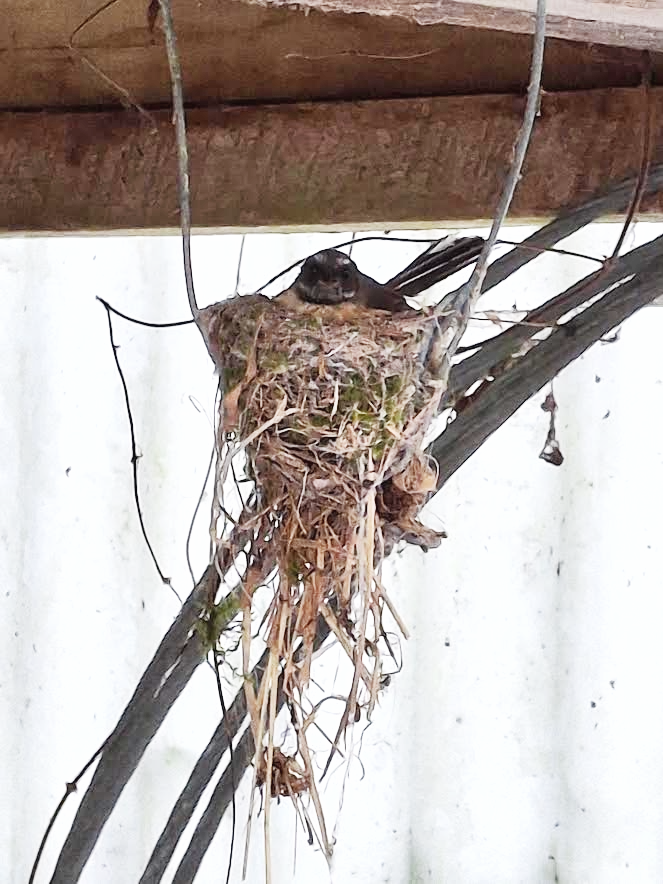
Over a few weeks, both parents flew pea straw, mosses and cobwebs to create a tiny soft and spongy cup. It’s perched on a loop of wire hanging from the rafters, with a long tail characteristic of fantail nests.
For fourteen days the parents took turns sitting in the nest cup. On the fifteenth day, the parents began hyperactively flying to and fro, darting about, catching bugs, and ferrying them to the new feeding chicks. In another fourteen days the chicks will fledge.
The ‘fantail’ genus comprises 51 different species, spread over Australasia, South East Asia and the Indian subcontinent. The literal meaning of their latin name rhipiduridae translates to – rhipis/rhipdos, fan, and oura which is tail.
Four subspecies have been found around New Zealand, the North Island (R. placabilis), South Island (R.fuliginosa), and Chatham Island variants, as well as a now extinct Lord Howe Island variant. The main difference between New Zealand fantails and those found in Australia and New Guinea are their calls. Here, there are pied and black coloured morphs. Black piwakawaka make up only 1% of North Island birds, and around 4% of those in the South Island. Seeing black ones is extra special.
Piwakawaka are also known as tīwakawaka and piwaiwaka. In our garden, they’re known as little darlings. Whatever they’re called, they’re distinctive and well loved, with their “confiding nature” – their friendly little flits attracted to people for the bugs we disturb. Piwakawaka are an omen of death in Māori mythology. But they’re really all about life and birth.
Piwakawaka have coped reasonably well with introduced pests and deforestation.
In the North Island they nest from August to March, and in the South Island, from September to January. They’re prolific little breeders, with between two and five broods a season. They lay three or four spotted grey and brown eggs, with both parents helping to build the nest, incubate and feed the young.
Incubation of subsequent nests might occur when the fledged young of the first brood are still being fed. And young males can start breeding just two months later. No wonder fantails are so common.
In places like Tawharanui, fantails flock with other little forest birds like pōpokatea – whiteheads and silver eyes. They also flock with saddlebacks. It’s a raucous ringing of tiny bells when they move through the forest together.
Fantails are almost never still, and are adept agile fliers as they dart around catching bugs. They are very alert to food potential – at home when we open our compost bin, they fly in for a bug feed on cue. Their beaks are specially equipped for bug capture, being flat and triangular. And it seems that somehow they can store a few at a time in those tiny beaks, because they return to the nest and feed their several chicks on each trip.
They eat moths, flies, beetles, spiders and occasionally, small fruit. They may bash bigger insects against branches to aid digestion.
Adult fantails weigh about 8 grams and grow to about 16 cm long, though half of that is their tail. Because they’re so tiny, in winter they often huddle together on a branch.
 Adorable images on the internet show up to 31 fantails huddled together in a line in a shed. The photo was taken in Mosgiel, and it gets very cold down there, so that’s a wise, and wonderful strategy.
They’re welcome to our shed all year round too.
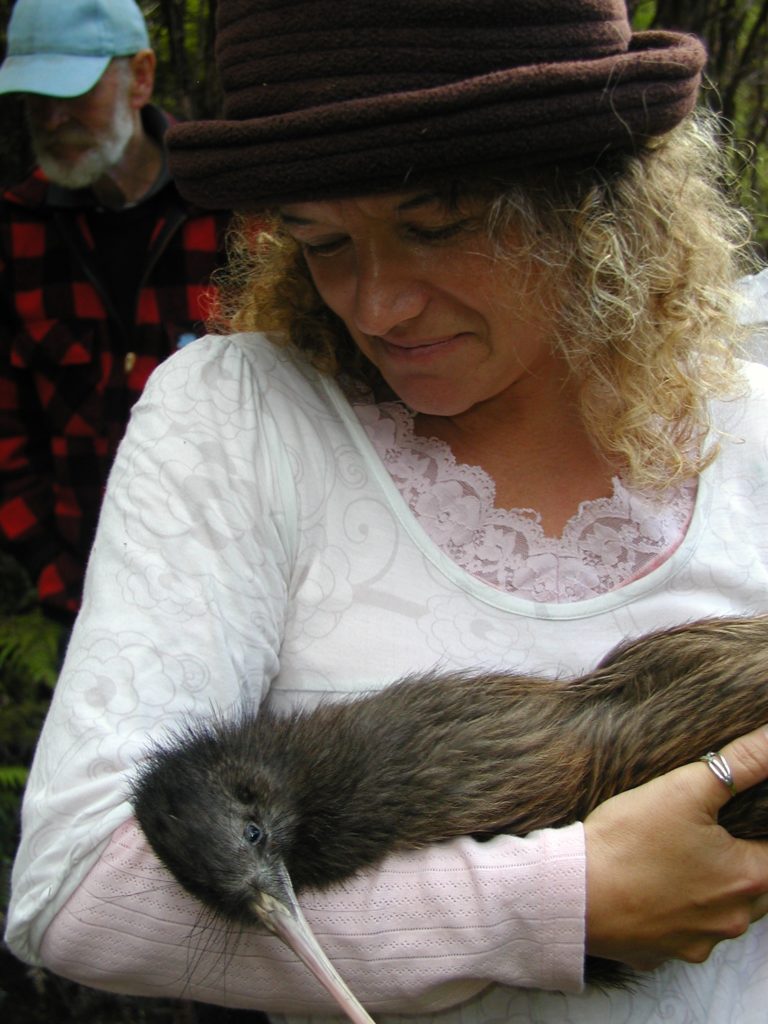
Christine Rose is a former Councillor for the Rodney District Council and the Auckland Regional Council, and was lead climate and agriculture campaigner for Greenpeace. A long time campaigner for the oceans, forests, and creatures of our planet, 25 years ago she founded, and has since run, the Māui and Hector’s Dolphin Defenders organization. Christine is a potter and painter, and says ‘I use art and politics to shape a better world.’

